From conversation to repeatable work

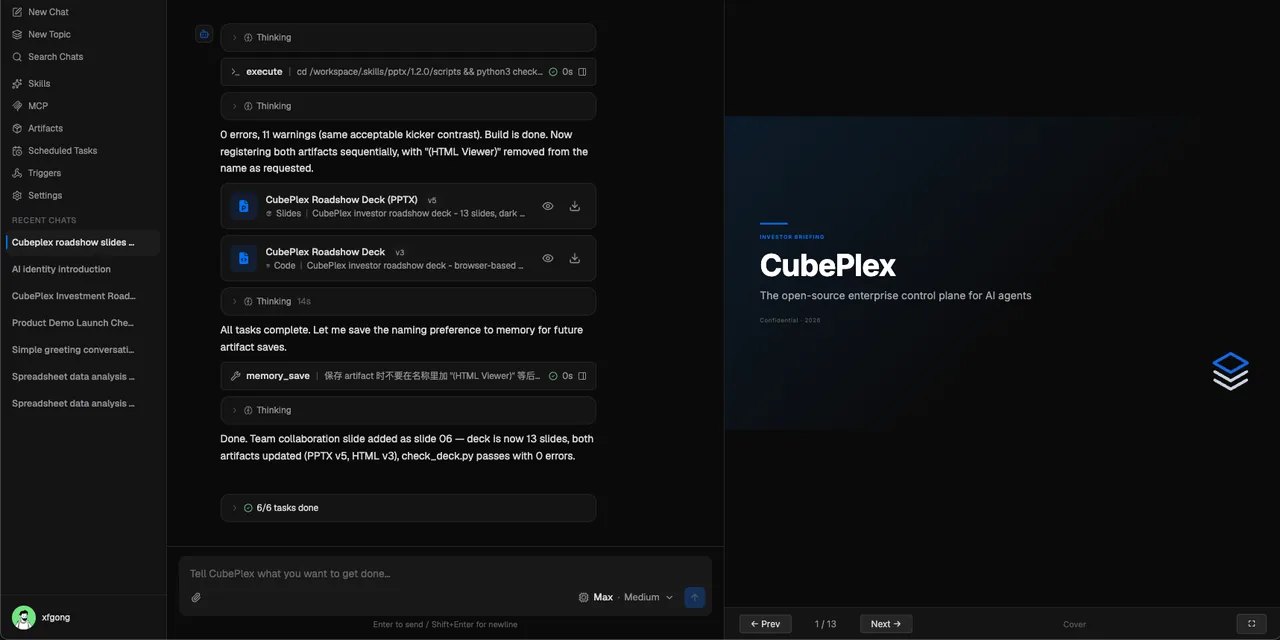
The first useful agent interaction often looks deceptively simple. Someone asks for help, the agent retrieves context, runs a tool, and produces an answer or artifact.
The next question is more important: can the team run that process again without reconstructing it from memory?
Keep the request attached to the result
Repeatable work starts by preserving the relationship between intent and output. The request should stay connected to the relevant files, tools, execution record, and artifact.
That record gives the next person a practical starting point. They can see what was asked, what context was available, and where judgment was applied. The workflow becomes easier to improve because the team can inspect the whole path, not only the final answer.
Turn a successful run into a shared pattern
Once a workflow proves useful, teams can make the pattern explicit:
- Define the input and the outcome that matters.
- Give the agent only the context and tools the task needs.
- Add a review point wherever an action should not proceed automatically.
- Keep outputs and traces with the work so the process can be evaluated.
The aim is not to eliminate human judgment. It is to reserve human judgment for the moments where it adds the most value.
Improve the system through real work
The best workflow design happens with real requests, real constraints, and real feedback. Each run reveals what context is missing, which tool should be easier to use, or where a policy needs to be clearer.
CubePlex gives teams the shared environment to make that improvement loop visible. Start with the work already happening in your team, then make the successful path easier to repeat.
Open-source projects
Bring agents into your team's day-to-day work
CubePlex
A self-hosted AI agent workspace for teams to handle document, data, and cross-system work with centralized access control and execution records.
View CubePlex sourceCubeLoop
A high-performance, traceable, async-native Python agent framework with production-grade persistence.
Visit CubeLoop