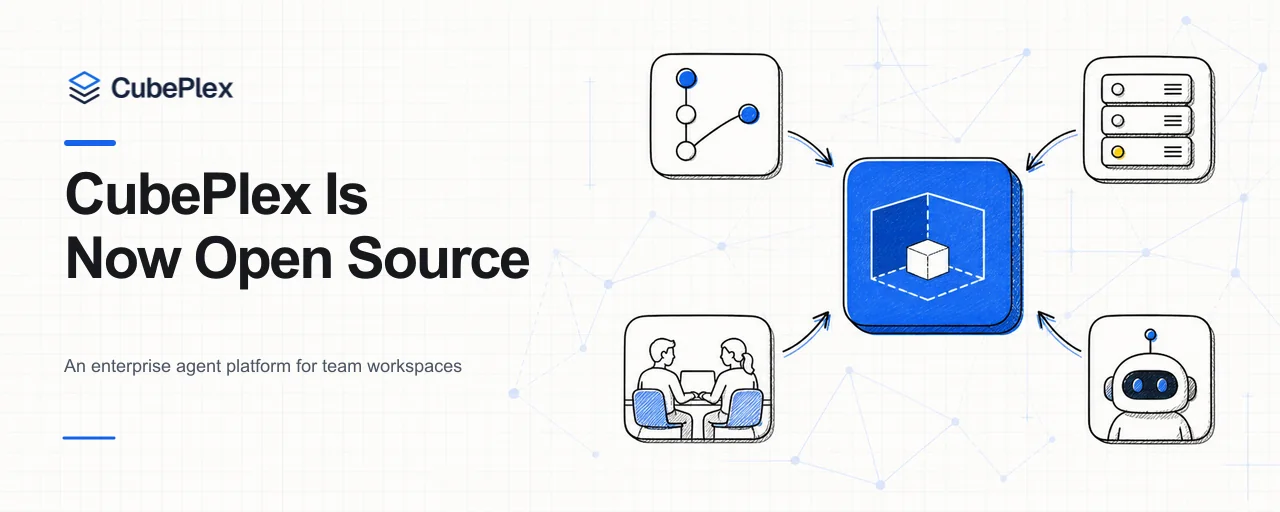
CubePlex is now open source. The source is available on GitHub under the Apache-2.0 license, including the backend, web application, deployment assets, and product documentation.
There is a simple test for whether an agent has moved from a personal tool into a team workflow: can someone else rerun a successful AI workflow without reconstructing it from chat history and one person's memory? Agents can already write code, research a topic, process files, and call external tools. The harder problem is increasingly how to keep that work usable after the first run.
CubePlex is an open-source workspace built for managed agents. It brings conversations, team members, skills, memory, MCP tools, and isolated execution environments into one collaborative space, so agent work can be inspected, continued, and run again.
Cloud agent platforms commonly use one of two architectures. The first puts an existing harness such as Claude Code, Codex, or OpenCode inside a sandbox. VibeKit and LiteLLM Agent Platform represent this approach, while Buzz also reuses these harnesses. The second keeps the agent loop in the control plane and uses sandboxes only for execution. Claude Managed Agents and OpenHands use this boundary, while products such as Manus and Perplexity Computer also appear closer to centrally scheduled execution. The first architecture fits automation with a clear start and finish. The second is a better fit for Managed Agents that may run for weeks or months, wait for events, and serve multiple users.
OpenSandbox and CubeSandbox both provide isolated code execution environments for agents, but they optimize for different infrastructure models. OpenSandbox manages sandboxes through Kubernetes resources and scheduling. CubeSandbox ships an integrated runtime stack from its control plane down to KVM MicroVMs, with an emphasis on high-concurrency creation, execution-state snapshots, and fast recovery.