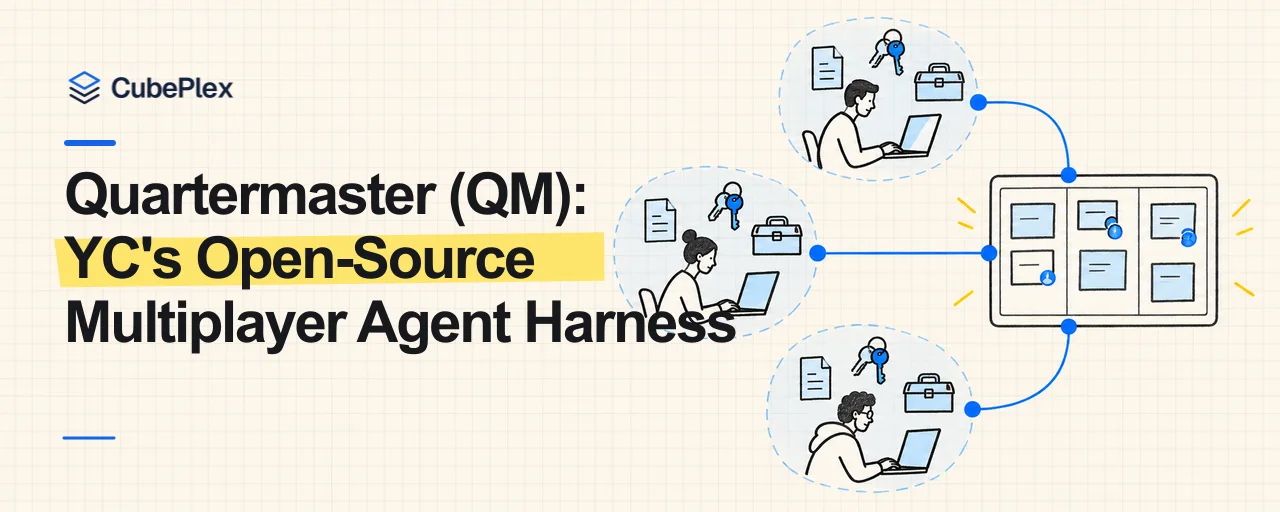
QM (Quartermaster) is YC's open-source, self-hosted multiplayer agent harness. It places people, Slack channels, groups, and projects in scopes, using each scope as an agent work environment and permission boundary. CubePlex is an open-source Agent Workspace for teams: it first defines a long-lived Workspace Agent, then lets Web, Slack, Discord, Microsoft Teams, Feishu/Lark, DingTalk, WeCom, and other entry points determine the conversation, identity, and execution boundary for a run.
The distinction changes everyday use. One model is suited to operating many independent agent computers under a company's permission and runtime system. The other is suited to keeping one team agent consistent across entry points without mixing private conversations, credentials, or execution environments.

YC open-sourced QM (Quartermaster) in July 2026. Its launch note describes starting with a Ruby agent loop that could reach internal data, adding crons and webhooks, and later giving individual employees more than 50 Hermes personal agents. Those agents were flexible, but managing the fleet became difficult.
QM is the result of that experience. It aims to retain the flexibility of a personal agent while giving an organization a way to manage models, permissions, and the runtime. Slack direct messages, channels, group DMs, and projects resolve to different scopes; collaboration happens inside those scopes rather than by handing one person's environment to the entire company.
Cloud agent platforms commonly use one of two architectures. The first puts an existing harness such as Claude Code, Codex, or OpenCode inside a sandbox. VibeKit and LiteLLM Agent Platform represent this approach, while Buzz also reuses these harnesses. The second keeps the agent loop in the control plane and uses sandboxes only for execution. Claude Managed Agents and OpenHands use this boundary, while products such as Manus and Perplexity Computer also appear closer to centrally scheduled execution. The first architecture fits automation with a clear start and finish. The second is a better fit for Managed Agents that may run for weeks or months, wait for events, and serve multiple users.